
Introduction: The New Era of Search
Search is evolving faster than ever. In 2025, the way users find information online has shifted from traditional keyword searches to AI-driven, conversational answers. Google’s AI Overviews, Bing Copilot, ChatGPT Search, and Perplexity are changing how users discover brands and content.
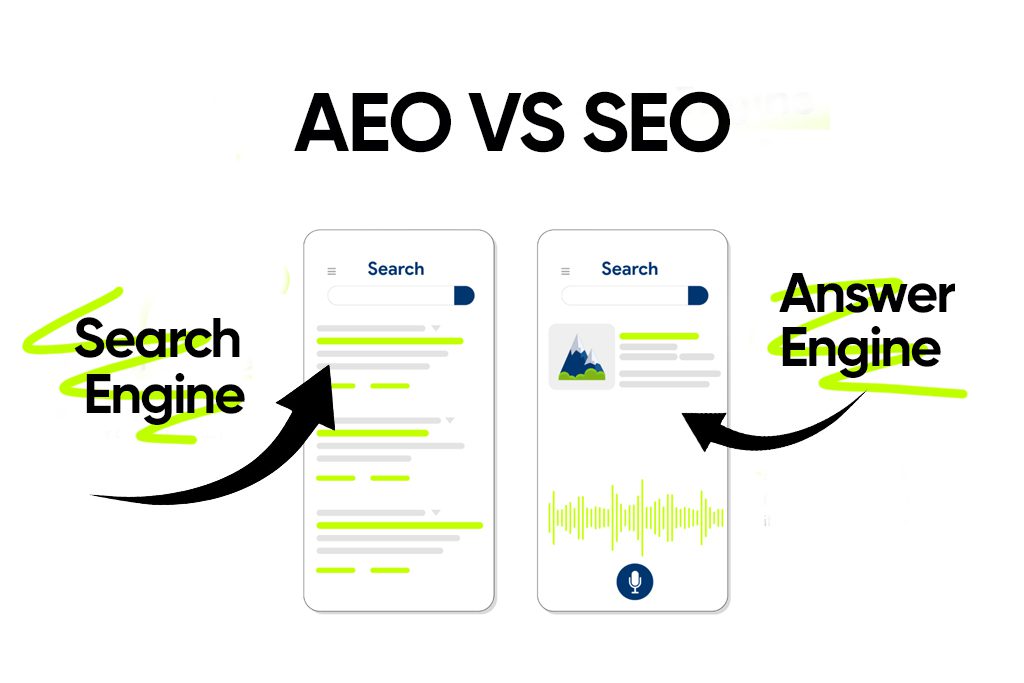
That’s where AEO (Answer Engine Optimization) comes in. While SEO (Search Engine Optimization) helps your pages rank higher on Google’s SERPs, AEO focuses on getting your content featured in AI-generated answers.
In this article, we’ll explore the key differences between SEO and AEO in 2025, why AEO matters for your digital strategy, and how both work together to shape the future of online visibility.
What Is SEO (Search Engine Optimization)?
SEO (Search Engine Optimization) is the process of optimizing your website and content to rank higher on search engine result pages (SERPs). The goal is to drive organic traffic by targeting keywords, improving site speed, optimizing backlinks, and creating valuable content that matches user intent.
Key Components of SEO in 2025:
- Keyword Optimization: Using relevant search terms to match user intent.
- Technical SEO: Improving site speed, mobile responsiveness, and crawlability.
- On-Page SEO: Optimizing meta titles, descriptions, and headings.
- Off-Page SEO: Building authority through backlinks and brand mentions.
- Content Strategy: Creating blogs, articles, and resources that provide value.
Even with AI changes, SEO remains foundational — it ensures that your website is visible, indexable, and credible to search algorithms.
What Is AEO (Answer Engine Optimization)?
AEO (Answer Engine Optimization) is the process of optimizing content for AI-driven answer engines — platforms like ChatGPT, Google AI Overviews, Bing Copilot, and voice assistants such as Siri or Alexa.
Instead of trying to rank your webpage, AEO helps you get cited or featured directly within AI answers.
When a user asks, “What are the best web design practices?” — instead of clicking through a list of websites, they now get an instant AI-generated answer. AEO ensures that your brand’s content is part of that answer.
Core Elements of AEO:
- Answer-Focused Content: Clear, concise, and factual responses.
- Semantic Optimization: Structuring content for AI understanding.
- Entity-Based SEO: Using schema markup and structured data.
- Conversational Tone: Writing naturally for voice and AI queries.
- Authority Building: Creating trustworthy, data-backed information.
AEO is all about helping AI find and trust your content enough to use it when generating responses.
SEO vs AEO: The Key Differences in 2025
| Aspect | SEO (Search Engine Optimization) | AEO (Answer Engine Optimization) |
| Goal | Rank pages on search engines | Get cited in AI-generated answers |
| Focus | Keywords and links | Questions and contextual answers |
| Content Style | Long-form, keyword-rich | Concise, factual, conversational |
| Target Platform | Google, Bing SERPs | ChatGPT, Google AI Overviews, Bing Copilot |
| Measurement | Rankings, CTR, traffic | Mentions, citations, answer appearances |
| Optimization Method | Meta data, backlinks, headings | Schema markup, NLP, entity recognition |
| User Behavior | Click-through search | Direct conversational query |
| Example Output | Your page ranks #1 on Google | Your brand appears inside the AI response |
Why AEO Is the Future of Search
As AI becomes more integrated into search experiences, users are asking questions in natural language instead of typing short keywords.
- AI search engines prefer structured, context-rich content.
- Voice assistants rely on clear and authoritative answers.
- Google’s AI Overviews pull summaries directly from high-quality content.
That means your brand needs to be recognized by AI models — not just search crawlers.
AEO makes your content machine-readable and contextually clear, allowing answer engines to extract your information more confidently.
How SEO and AEO Work Together
Despite their differences, SEO and AEO are not competitors — they’re complementary.
Here’s how they align:
- SEO builds discoverability. It ensures your site is crawlable and authoritative.
- AEO builds visibility in AI results. It helps your brand appear inside AI-generated answers.
- Together, they boost omnichannel presence. You’ll appear both in Google results and in conversational AI outputs.
Example:
A well-optimized blog on “Web Design Trends in California” (SEO)
With structured FAQs, schema markup, and conversational phrasing (AEO)
Result: Your page ranks on Google and appears in ChatGPT or Bing Copilot’s answers.
How to Prepare Your Content for AEO
To make your website ready for the future of AI search, start applying these AEO best practices:
- Write Answer-Based Content: Begin your blogs with direct responses to common questions.
- Use FAQ Sections: Add schema-based FAQs to increase answer visibility.
- Leverage Structured Data: Use Schema.org markup to help AI interpret content.
- Focus on Conversational Tone: Write naturally as if responding to a question.
- Build Topical Authority: Publish expert-level, research-backed content.
- Optimize for Entities, Not Just Keywords: Mention brands, places, and concepts clearly.
- Stay Updated with AI Search Tools: Track performance using tools that monitor AI Overviews and ChatGPT citations.
The Future of SEO and AEO
In 2025 and beyond, SEO will evolve into AEO-first strategies.
Brands that adapt early will lead AI search visibility — earning more brand mentions, authority, and trust.
Traditional SEO is still crucial, but it’s no longer enough on its own.
By combining SEO’s structure with AEO’s conversational approach, you can future-proof your digital presence for AI-driven discovery.
Conclusion
SEO helps your content get found — AEO helps it get chosen.
In the fast-changing world of AI search, businesses that master both will dominate online visibility.
Whether users type a keyword or ask an AI assistant, your brand should be ready to deliver the answer.
Start optimizing for Answer Engine Optimization today, and ensure your business stays visible in the next generation of search.


